

Cadence ChipStack AI Super Agent Targets Front-End Design and Verification
Cadence Design Systems has announced the launch of its ChipStack AI Super Agent, an agentic AI workflow designed to automate and accelerate front-end chip design and verification tasks.
Announced on 10 February 2026, the new Cadence ChipStack AI platform positions itself as an orchestration layer that coordinates multiple AI agents across RTL development and functional verification
The announcement forms part of Cadence’s broader Intelligent System Design strategy, which integrates AI, simulation and accelerated computing to address increasing semiconductor design complexity.
What Is Cadence ChipStack AI?
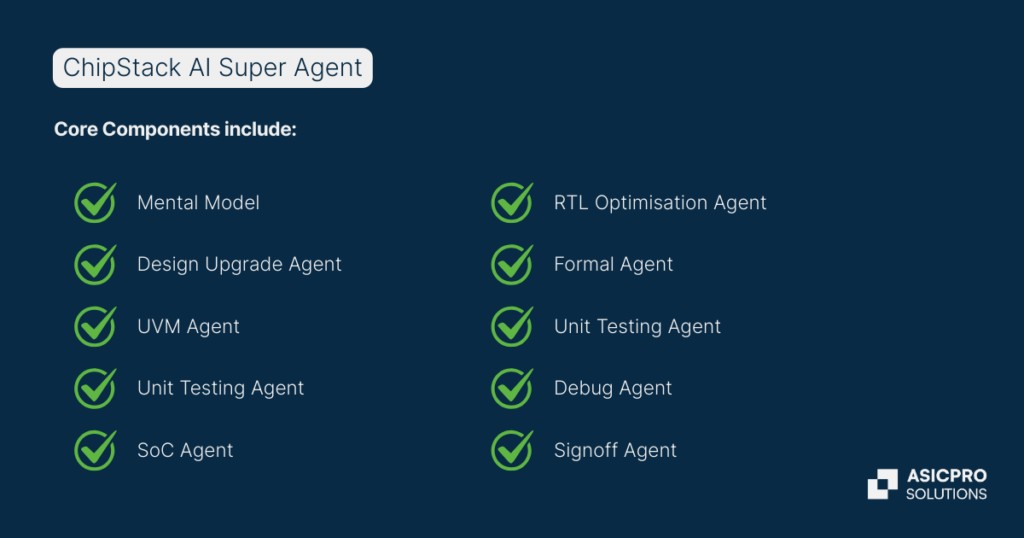
According to Cadence, the ChipStack AI Super Agent is an agentic AI workflow built to coordinate specialised AI agents across the front-end design process. Rather than operating as a single prompt-based assistant, ChipStack uses multiple task-focused agents capable of:
- Generating RTL code
- Creating testbenches
- Developing verification test plans
- Orchestrating regression runs
- Debugging failures and proposing fixes
Cadence claims the platform can deliver up to 10× productivity improvements across these engineering workflows.
How ChipStack Integrates with Existing Cadence EDA Tools
An important point to note: Cadence ChipStack AI is not a new simulation engine or synthesis tool. Instead, it operates as an AI orchestration layer that invokes and coordinates existing Cadence technologies.
The workflow integrates with established platforms including:
- Verisium Verification Platform
- Cerebrus Intelligent Chip Explorer
- JedAI data and AI infrastructure
ChipStack supports both cloud-based and on-premises AI deployment models, including integration with open and hosted AI models. By coordinating tools and agents through a shared contextual model of the design, Cadence aims to reduce manual handoffs, accelerate verification feedback loops and improve workflow efficiency.
What This Means for ASIC Design and Verification Teams
For ASIC design and verification engineers, the Cadence ChipStack AI announcement signals continued movement toward AI-driven workflow automation rather than isolated tool acceleration.
“Our customers are facing a significant senior deficit in the engineering talent needed to deliver on their product roadmaps,” said Paul Cunningham, vice president and general manager of Research and Development, Cadence. “Our ChipStack AI Super Agent is a game changer for design and verification productivity, and deployments are ramping fast.”
If adopted at scale, this type of agentic AI orchestration has the potential to:
- Reduce repetitive verification setup work
- Shorten regression turnaround times
- Improve debugging efficiency
- Help manage growing design and test complexity
While productivity claims will ultimately be validated in production environments, the direction is clear: AI is shifting from optional support to embedded workflow coordination inside the EDA stack.
The Cadence ChipStack AI Super Agent is available in early access. For more information, explore the official announcement →