
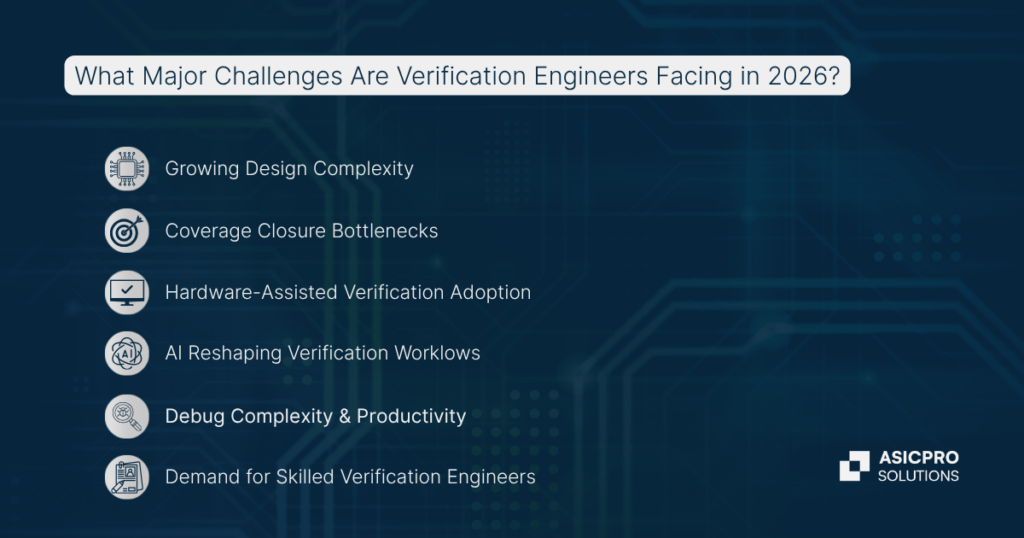
What Major Challenges Are Verification Engineers Facing in 2026?
As semiconductor devices continue to grow in complexity, ASIC verification is becoming one of the most demanding stages of chip development. Modern designs integrate billions of transistors, heterogeneous IP, AI accelerators, advanced interconnects, and increasingly complex software interactions, all while project timelines continue to shrink.
For verification engineers, this means balancing thoroughness with efficiency. Teams must find ways to improve coverage, reduce debug time, and adopt new technologies without compromising design quality or delaying tape-out.
While verification methodologies continue to evolve, several key challenges are shaping the industry in 2026. Here’s an overview of the major issues many verification teams are working to address.
Growing Design Complexity
Today’s System-on-Chip (SoC) designs combine CPUs, GPUs, AI engines, security modules, memory subsystems and multiple third-party IP blocks within a single device.
As integration increases, so too does the number of interactions that must be verified. Engineers must validate not only individual IP functionality but also how these components behave together under real-world operating conditions. This growing complexity makes scalable verification planning and effective IP reuse more important than ever.
Coverage Closure Bottlenecks
Achieving coverage closure continues to be one of the most time-consuming aspects of modern verification.
Collecting code, functional, and assertion coverage is only part of the challenge. Verification teams must determine whether uncovered scenarios represent genuine verification gaps or simply unreachable conditions. Chasing the final percentage points of coverage can consume significant engineering effort, particularly on large SoCs with millions of possible states.
As projects grow larger, many teams are focusing on improving the quality of coverage analysis rather than simply targeting higher coverage numbers.
Hardware-Assisted Verification Is Moving into the Mainstream
Simulation remains a cornerstone of ASIC verification, but it is often no longer sufficient on its own for today’s largest designs.
Hardware-assisted verification techniques, including emulation and FPGA prototyping, allow engineers to validate software, run longer test scenarios, and uncover issues that may be impractical to find through simulation alone. These platforms can significantly reduce verification time for complex projects while enabling earlier software development.
For many verification engineers, this is a relatively new area. Not everyone has had direct experience with emulation or FPGA-based workflows, which means teams often face a learning curve when adopting these methods. That makes hardware-assisted verification both an opportunity and a challenge: it can improve confidence before tape-out, but it also requires new skills, new processes, and closer collaboration across hardware and software teams.
As chip complexity increases, many organisations are adopting hybrid verification strategies that combine simulation, formal methods, and hardware-assisted verification to improve confidence before tape-out.
Trends Shaping ASIC Verification in 2026
Beyond these core challenges, verification engineers are also adapting to several broader trends that are reshaping the profession. AI-assisted verification tools are beginning to streamline tasks and are helping teams improve productivity. At the same time, the increasing size and complexity of modern SoCs mean that debug continues to consume a significant portion of verification effort, making automation and more intelligent debug workflows increasingly valuable.
Another challenge extends beyond technology itself: demand for experienced verification engineers remains high. As methodologies, tools and device complexity continue to evolve, organisations are investing in training, reusable verification environments and standardised processes to help teams scale effectively while developing the next generation of verification talent.
Looking Ahead: The Future of Semiconductor Verification
Verification has always evolved alongside advances in semiconductor technology, and 2026 is proving no different. While growing design complexity, tighter schedules and new verification methodologies continue to raise the bar, they are also driving innovation across the industry.
This article has highlighted some of the biggest challenges facing verification engineers today, but each topic deserves a deeper discussion. In future articles, we’ll explore these areas in greater depth, from hardware-assisted verification to the growing role of AI in verification workflows. As the semiconductor industry continues to evolve, staying informed about these trends will help teams make more confident decisions and build increasingly reliable silicon.